


Last week, we said all bets were off until we saw Friday’s jobs report—and that no other piece of economic data moves mortgage rates more reliably. This week proved why that warning is always worth repeating.
It’s not that the rest of the week was boring. In fact, the calendar from Monday through Thursday was packed with potentially interesting updates. Highlights included the Fed announcement on Wednesday, the latest inflation data on Thursday (via the PCE report), and a first look at Q2 GDP. But while those events offered a few moments of movement in the bond market, none of them caused much drama for mortgage rates.
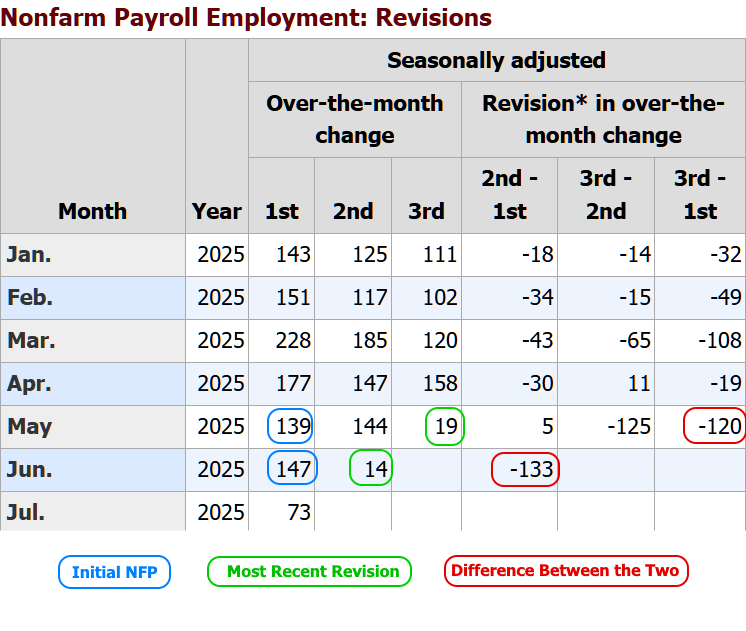
That changed in a big way on Friday when the big jobs report (officially called “nonfarm payrolls”) came in much weaker than expected. The headline showed 73,000 new jobs versus a forecast of 110,000. That's really only a moderate miss when it comes to this report and not enough in and of itself to put on the show we ended up seeing.
The real story was in the revisions. Payroll counts are always revised as more companies report to the Bureau of Labor Statistics (BLS). This happens for 2 months after the initial release. These 2 months of revisions were uncharacteristically big, accounting for a combined 253,000 reduction in the job count thus significantly downgrading the recent picture of the labor market.
Why does that matter for mortgage rates? Because a slower labor market leads to more bond buying, which in turn pushes rates lower. It also makes the Fed more likely to cut rates. Mortgage rates aren't tied to the Fed rate, but they do move lower in anticipation if a rate cut is widely expected. You could say that mortgage rates don't correlate well with the Fed Funds Rate itself, but very well with Fed Funds Rate expectations. And here's what those expectations did on Friday:
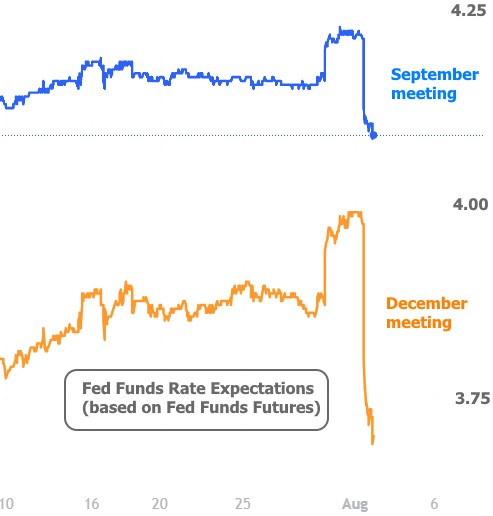
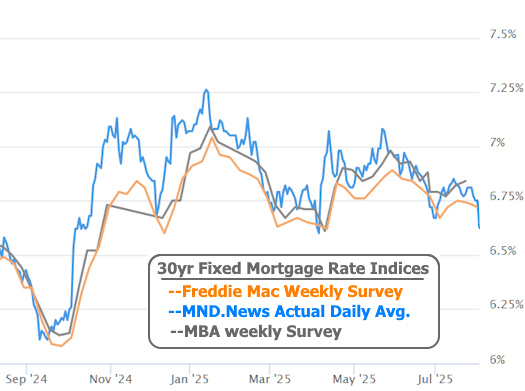
Mortgage rates followed suit with the average lender offering some of their best rates since early April. Some lenders even made mid-day improvements as markets continued to rally.
By the end of the day Friday, the average 30-year fixed rate had fallen by roughly an eighth of a percent, bringing us within striking distance of the lowest levels since October 2024.
Looking ahead, this jobs report puts much more weight on the next round of data. Inflation reports will be closely watched, but so will the next jobs report in early September—just two weeks before the next Fed meeting. Markets are now actively pricing in the possibility of a rate cut at that meeting. Whether or not it actually happens will depend entirely on how the incoming data stacks up.
For now, the takeaway is simple: this was a good week for mortgage rates, and it came thanks to a labor market report that strongly suggested things are cooling off. If that trend continues, rates could move lower still. If not, the recent improvement could be short-lived.


